EV Statistics 2026: 35 Key Data Points
By WattCabin · 8 min read · Updated June 2026
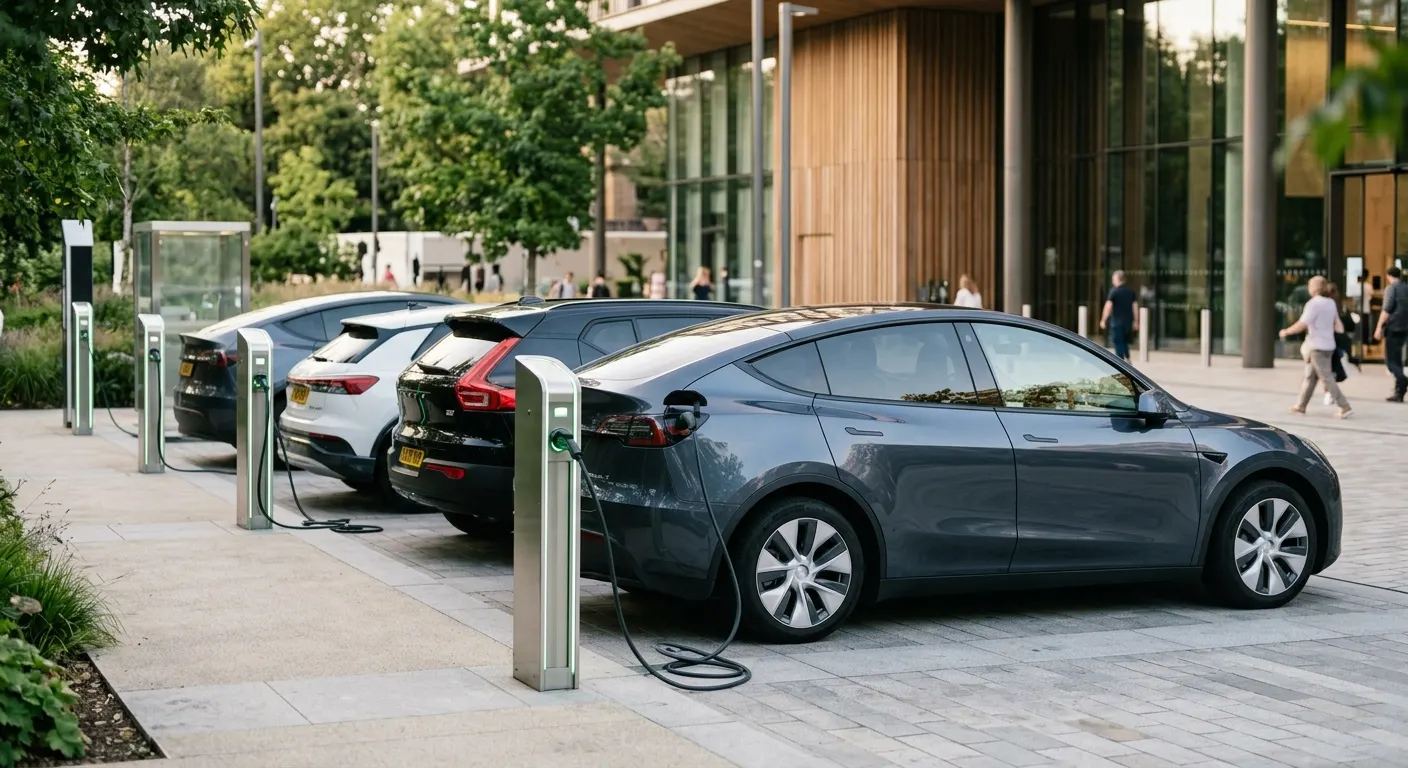
Electric vehicles crossed from niche to mainstream in the run-up to 2026, and the data tells a clearer story than any headline. This roundup pulls together 35 verified statistics on EV and Tesla adoption, market value, prices, charging, and who is actually buying. Every figure below is drawn from a named primary source, from Cox Automotive and the International Energy Agency to BloombergNEF, the US Department of Energy, and Experian. Use it as a reference, and cite the original source for any number you reuse.
Quick answer
The headline number for 2026 readers: global electric car sales topped 17 million in 2024, up more than 25 percent year over year, and the International Energy Agency projects sales will exceed 20 million in 2025, more than one quarter of all cars sold worldwide. EVs are now mainstream.
This guide contains affiliate links. WattCabin may earn a commission at no cost to you.
US EV sales and market share
According to the Cox Automotive and Kelley Blue Book Q4 2024 report, US EV sales hit a record 1,301,411 units in full-year 2024, up 7.3 percent year over year. The same report puts EV share of total US new-vehicle sales at 8.1 percent, up from 7.8 percent in 2023. The fourth quarter of 2024 was the best quarter on record at the time, with 365,824 units sold, up 15.2 percent year over year.
That momentum carried into 2025. The Cox Automotive and Kelley Blue Book Q3 2025 report records an all-time quarterly high of 438,487 EVs sold, up 29.6 percent year over year, lifting EV share of the US market to a record 10.5 percent, up from 8.6 percent a year earlier.
Counting hybrids alongside pure EVs shows how fast the broader shift is moving. According to Motor Intelligence data reported by CBT News, combined EV and hybrid sales reached 20 percent of US new-vehicle sales for the first time in 2024, pushing gas and diesel down to 79.8 percent, below 80 percent for the first time. That same source counts 3.2 million total electrified vehicles sold in the US in 2024, made up of 1.9 million hybrids and plug-in hybrids plus 1.3 million all-electric vehicles.
Experian Automotive offers a registration-based view in its Electric Vehicles 2024 Year in Review. Experian counts about 4 million EVs on US roads in 2024, or 1.4 percent of the 292.3 million vehicles in operation, and roughly 1.1 million of 12.4 million new registrations that year, a 9.2 percent share.
The global EV picture
The International Energy Agency Global EV Outlook 2025 frames the worldwide picture. It reports that more than 17 million electric cars were sold globally in 2024, up more than 25 percent year over year, and that more than 20 percent of all new cars sold worldwide were electric. The global electric car fleet on the road reached almost 58 million by the end of 2024, about 4 percent of the total passenger car fleet.
China dominates that total. The same IEA outlook reports that China alone sold over 11 million electric cars in 2024, more than all global EV sales just two years earlier. On the IEA basis, which includes plug-in hybrids, US electric car sales reached 1.6 million in 2024 with a sales share above 10 percent.
Looking ahead, the IEA projects global electric car sales will exceed 20 million in 2025, more than one quarter of all cars sold worldwide. According to Fortune Business Insights, the global EV market was valued at 927.69 billion dollars in 2025 and is projected to reach 2,190.37 billion dollars by 2034, a compound annual growth rate of 9.97 percent. The same source puts Asia Pacific at 51.78 percent of the global market in 2025.
Where Tesla stands
Tesla remains the reference point for the EV market, though 2024 marked a turn. According to Tesla figures reported by Just-Auto, Tesla delivered 1,789,226 vehicles globally in full-year 2024 and produced 1,773,443, its first annual delivery decline in over a decade, down about 1.1 percent year over year. The same report shows 495,570 deliveries in the fourth quarter of 2024 against 459,445 produced.
Tesla still leads the US, but by a narrower margin. According to Cox Automotive data reported by Teslarati, Tesla held roughly 48.6 percent of the US EV market in 2024, about 633,000 US units, down from 55 percent in 2023. The Model Y and Model 3 together accounted for over 40 percent of all EVs sold in the US that year.
Globally, the Model Y set a record before that dip. According to JATO Dynamics, the Tesla Model Y was the world's best-selling vehicle in 2023 at 1.22 million units, up 64 percent year over year, the first pure EV ever to lead global sales.
Costs, prices, and savings
The case for going electric increasingly rests on running costs. According to Consumer Reports, EV owners who charge mostly at home save roughly 800 to 1,000 dollars per year on fuel versus a comparable gas car, and typically 6,000 to 10,000 dollars over the life of the vehicle, with maintenance and repair costs about half those of a gas car.
Sticker prices and battery costs tell a more nuanced story. According to Kelley Blue Book and Cox Automotive, the average US EV transaction price was 54,021 dollars in March 2024, against 47,218 dollars for all new vehicles.
According to BloombergNEF, the average lithium-ion battery pack price fell to a record low of 115 dollars per kilowatt-hour in 2024, down 20 percent from 2023, the biggest drop since 2017. BloombergNEF also notes the cheapest regional packs were in China at 94 dollars per kilowatt-hour, with US packs 31 percent higher and Europe 48 percent higher.
Range and charging
Range and charging have matured alongside the market. According to the US Department of Energy Fact of the Week 1375, the median range of model-year 2024 EVs reached a record 283 miles per charge, up 13 miles year over year and more than four times the model-year 2011 median.
The charging network has scaled to match. According to the US DOE Alternative Fuels Data Center, the US had 168,388 public charging ports across 64,641 public station locations in 2023. According to the Tesla Q4 2024 report compiled by EV Charging Stations, the Tesla Supercharger network reached 6,975 DC fast-charging stations and 65,495 connectors globally by the end of the fourth quarter of 2024, up 17 percent and 19 percent year over year.
Most charging happens at home. According to the J.D. Power EV Experience Home Charging Study reported by InsideEVs, 86 percent of EV charging happens at home, and the average owner spent 63 dollars on home charging in the prior 30 days. For owners wiring up a permanent setup, a Level 2 home charger like the Tesla Wall Connector (Gen 3) is the core upgrade that makes that home-charging share practical.
Who buys EVs
Who buys EVs skews toward higher income, younger, and more diverse households. According to Numerator, 44 percent of EV owners come from high-income households, against 30 percent of all vehicle owners, and 42 percent of EV owners are Gen Z or Millennial, against 30 percent of all owners. Numerator also reports that 44 percent of EV owners are Black, Hispanic, or Asian, against 31 percent of all owners, and that 77 percent of EV households own two or more vehicles, against 68 percent of all vehicle-owning households.
Attitudes still gate adoption. According to YouGov, the top barrier to EV adoption among US buyers in 2024 was high upfront cost, cited by 40 percent, followed by charging time at 36 percent and limited charging availability at 31 percent. The same survey found 28 percent of prospective car buyers were considering an EV in the next 12 months.
Sources
Cox Automotive and Kelley Blue Book, US EV sales and market share, Q4 2024 report, 2024.
Cox Automotive and Kelley Blue Book, US EV sales and market share, Q3 2025 report, 2025.
Motor Intelligence, via CBT News, US EV and hybrid market share, 2024.
Tesla, via Just-Auto, Tesla 2024 deliveries and production, 2024.
Cox Automotive, via Teslarati, Tesla US EV market share, 2024.
JATO Dynamics, Tesla Model Y as world's best-selling vehicle, 2023.
International Energy Agency, Global EV Outlook 2025, global and US EV trends, 2024 and 2025.
Experian Automotive, Electric Vehicles 2024 Year in Review, US EVs in operation, 2024.
Fortune Business Insights, global EV market value and regional share, 2025.
Kelley Blue Book and Cox Automotive, average EV transaction price, March 2024.
BloombergNEF, lithium-ion battery pack prices, 2024.
Consumer Reports, EV fuel and ownership savings, 2020.
US Department of Energy, Fact of the Week 1375, median EV range, 2024.
US DOE Alternative Fuels Data Center, US public charging ports, 2023.
EV Charging Stations, Tesla Supercharger network Q4 2024 report, 2024.
J.D. Power, EV Experience Home Charging Study, via InsideEVs, home charging, 2026.
Numerator, EV owner demographics, 2024.
YouGov, US EV adoption attitudes, 2024.
Keep reading
Related comparisons
Related roundups
FAQ
Frequently asked questions
How many EVs were sold in the US in 2024?+
US EV sales reached a record 1,301,411 units in full-year 2024, up 7.3 percent year over year, according to the Cox Automotive and Kelley Blue Book Q4 2024 report. That worked out to 8.1 percent of all new-vehicle sales, up from 7.8 percent in 2023. The fourth quarter alone added 365,824 units, the best quarter on record at the time.
What percentage of new cars sold are electric?+
It depends on the market. In the US, EV share reached a record 10.5 percent in the third quarter of 2025, per Cox Automotive and Kelley Blue Book, up from 8.6 percent a year earlier. Globally, the International Energy Agency reports more than 20 percent of all new cars sold worldwide in 2024 were electric, and projects more than one quarter in 2025.
Is the EV market still growing?+
Yes, strongly. The International Energy Agency reports global electric car sales topped 17 million in 2024, up more than 25 percent year over year, and projects more than 20 million in 2025. US sales set an all-time quarterly record of 438,487 units in the third quarter of 2025, up 29.6 percent year over year, according to Cox Automotive and Kelley Blue Book.
How big is the global EV market?+
Fortune Business Insights valued the global EV market at 927.69 billion dollars in 2025 and projects it will reach 2,190.37 billion dollars by 2034, a compound annual growth rate of 9.97 percent. Asia Pacific accounted for 51.78 percent of that market in 2025, the largest regional share by a wide margin.
How much does an EV save versus a gas car?+
According to Consumer Reports, EV owners who charge mostly at home save roughly 800 to 1,000 dollars per year on fuel versus a comparable gas car, and typically 6,000 to 10,000 dollars over the life of the vehicle. Maintenance and repair costs run about half those of a gas car. Most charging, 86 percent per J.D. Power, happens at home.
What is the biggest barrier to buying an EV?+
High upfront cost, according to YouGov. In its 2024 survey of US buyers, 40 percent named upfront cost as the top barrier, followed by charging time at 36 percent and limited charging availability at 31 percent. Even so, 28 percent of prospective car buyers said they were considering an EV in the next 12 months.