Tesla Ownership Cost Statistics 2026: 20 Data Points
By WattCabin · 7 min read · Updated July 2026
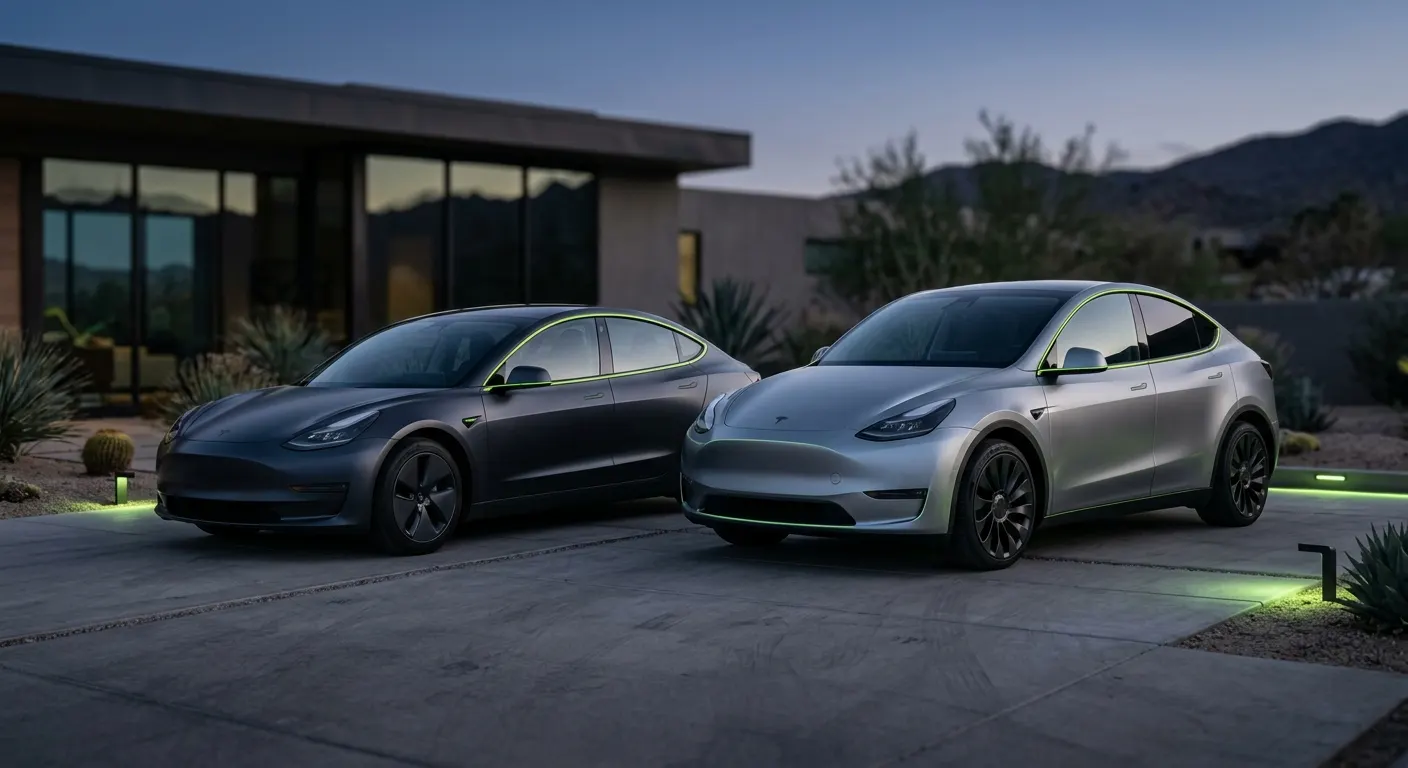
The sticker price is only the start of what a Tesla actually costs to own. This roundup pulls together 20 sourced statistics on what happens after the purchase: how fast a Model 3 or Model Y loses value, what routine maintenance really runs per year, how Tesla now ranks on reliability, and why insurance premiums have climbed so sharply. Every figure below is drawn from a named source, from CarEdge and iSeeCars to Consumer Reports, J.D. Power, and Insurance.com. Use it as a reference, and cite the original source for any number you reuse.
Quick answer
The headline numbers for 2026 buyers: a Tesla Model Y depreciates about 61 percent over 5 years (CarEdge), routine maintenance runs roughly $500 to $650 a year for a Model 3 or Model Y (Recharged), Tesla jumped to 9th of 26 brands in Consumer Reports 2026 reliability ranking, and average Tesla insurance now runs about $4,512 a year (Insurance.com).
This guide contains affiliate links. WattCabin may earn a commission at no cost to you.
How fast a Tesla depreciates
According to CarEdge, a Tesla Model Y loses about 31 percent of its value in the first year alone (resale value $34,541 on a $50,380 starting price), and depreciation compounds to 58.1 percent by year 3 (resale value $21,119) and 61 percent by year 5 (resale value $19,608).
The Model 3 follows a similar curve. CarEdge puts Model 3 first-year depreciation at 30 percent (resale value $35,945), climbing to 57.8 percent by year 3 (resale value $21,677) and 61 percent by year 5 (resale value $20,136).
iSeeCars, drawing on an analysis of over 15 million vehicles, tracks the Model 3 further out: 54.5 percent depreciation at 5 years, 64.3 percent at 7 years (resale value $13,190.68), and 74.8 percent at 10 years (resale value $9,309.70). For context, iSeeCars places luxury electric compacts like the Model 3 at 54.5 percent five-year depreciation versus 38.9 percent for all sedans and a 41.5 percent all-vehicle average, meaning Teslas depreciate faster than the typical car in the same window.
What maintenance actually costs
According to Recharged, routine annual maintenance on a Model 3 or Model Y runs roughly $500 to $650 a year, or about $2,500 to $3,250 over 5 years. A Model S or Model X runs higher, about $700 to $800 a year and $3,500 to $4,000 over 5 years.
That compares favorably with a gas car. Recharged’s side-by-side at 12,000 miles a year puts a Model 3 or Model Y at $500 to $850 annually versus $950 to $1,500 for a comparable gas mid-size sedan or SUV. Aggregated RepairPal-based estimates cited by Recharged put the Model 3 near $3,222 in total maintenance and repair costs over its first 10 years, and the Tesla lineup overall around $4,281, both well below the luxury-vehicle average.
Regenerative braking is a real factor in that gap. AutoNation Mobile Service notes Tesla brake pads often last 100,000 or more miles under normal driving, well beyond a typical gas car’s brake-service interval. A cabin that stays organized and protected compounds those savings by keeping wear items like the trunk carpet and console trim from needing early replacement; a Tesmanian All-Weather Trunk & Frunk Mat Set (Model X) or a BASENOR 4PCS TPU Center Console Organizer Set are the kind of cheap, preventative buys that protect resale-relevant surfaces the depreciation numbers above are already pricing in.

Tesmanian All-Weather Trunk & Frunk Mat Set (Model X)
TPE cargo mats sized for the Model X trunk and frunk to keep spills and dirt off the carpet.

BASENOR 4PCS TPU Center Console Organizer Set
Tested-winner for Highland/Juniper, dual-layer TPU with a 0.3mm precision fit, cupholder to armrest in one box.
Reliability: Tesla’s biggest jump yet
Consumer Reports’ 2026 Automotive Brand Report Card (published December 2025) ranked Tesla 9th of 26 brands tested, up from 17th the year before, an 8-spot jump that was the largest gain of any brand in the ranking. Coverage of the same report noted Tesla ranked 27th of 28 brands as recently as 2022, making this a multi-year turnaround rather than a one-year blip.
Within that ranking, Consumer Reports found the Model 3 to be the most reliable electric car in its survey and the Model Y the most reliable electric SUV and the most reliable EV overall. The Cybertruck was called out separately as below-average, so the gain is concentrated in Tesla’s two highest-volume models.
The J.D. Power 2025 U.S. Vehicle Dependability Study tells a more mixed story: Tesla logged 209 problems per 100 vehicles (PP100) against an industry average of 202 PP100, a below-average result, though J.D. Power notes Tesla is excluded from its official brand rankings because the company restricts owner-name access in a number of states, so the figure comes from survey responses collected elsewhere.
Why insurance costs so much more
Insurance is the ownership cost that has climbed fastest. According to Insurance.com, the average Tesla costs $4,512 a year to insure versus $3,037 a year for all vehicles nationally, about 49 percent higher.
By model, Insurance.com puts 2025 Model 3 insurance at $3,871 a year ($323 a month), up from $3,466 in 2024, a $405 single-year jump that was the largest increase in its 2020-to-2025 tracked series (which ran $3,175 in 2020, $3,214 in 2021, $3,406 in 2022, and $3,458 in 2023 before that final jump). The Model Y runs close behind at $3,836 a year ($320 a month) for 2025.
The same source ties the increase to repair complexity and parts cost: Tesla’s electric drivetrain needs specialized tools and technicians to service, and the car’s higher purchase price feeds directly into higher comprehensive and collision premiums.
Sources
CarEdge, Tesla Model Y depreciation, 2026.
CarEdge, Tesla Model 3 depreciation, 2026.
iSeeCars.com, Tesla Model 3 resale value and depreciation, 2026.
Recharged, Tesla Yearly Maintenance Cost in 2025, 2025.
Recharged, Cost to Maintain a Tesla in 2025, 2025.
AutoNation Mobile Service, Tesla Reliability, 2025.
Consumer Reports 2026 Automotive Brand Report Card, via Forbes, CNBC, Bloomberg, and evxl.co coverage, 2025.
J.D. Power 2025 U.S. Vehicle Dependability Study, via GearJunkie coverage, 2025.
Insurance.com, Tesla insurance cost breakdown, 2026.
Keep reading
Related comparisons
Related roundups
FAQ
Frequently asked questions
How much does a Tesla depreciate?+
A lot, and fast. CarEdge puts 5-year depreciation at about 61 percent for both the Model Y and Model 3, meaning a car bought new for roughly $50,000 is worth about $19,000 to $20,000 five years later. iSeeCars’ broader dataset shows the Model 3 depreciating faster than the average sedan over the same window: 54.5 percent versus 38.9 percent for all sedans.
How much does it cost to maintain a Tesla per year?+
Roughly $500 to $650 a year for a Model 3 or Model Y in routine maintenance, according to Recharged, which is less than the $950 to $1,500 a comparable gas sedan or SUV runs annually. Brake pads in particular last much longer thanks to regenerative braking, often 100,000-plus miles per AutoNation Mobile Service.
Is Tesla reliable in 2026?+
More reliable than it used to be. Consumer Reports’ 2026 Automotive Brand Report Card ranked Tesla 9th of 26 brands, up 8 spots from 17th the year before, with the Model 3 and Model Y singled out as the most reliable EVs in the survey. J.D. Power’s 2025 study is less flattering: 209 problems per 100 vehicles against a 202 industry average, a below-average score, though Tesla is excluded from J.D. Power’s official rankings over its owner-data access policy.
Why is Tesla insurance so expensive?+
Higher purchase price and specialized repair costs. Insurance.com puts average Tesla insurance at $4,512 a year, about 49 percent above the $3,037 national average for all vehicles. The Model 3 jumped $405 in a single year, from $3,466 in 2024 to $3,871 in 2025, the largest year-over-year increase in its tracked history.
Does a Tesla Model 3 or Model Y hold value better?+
They are close. CarEdge shows near-identical 5-year depreciation for both, about 61 percent, though the Model Y holds a slightly higher resale value in dollar terms ($19,608 vs $20,136 are close enough that trim and mileage matter more than the model choice itself). Both lose the most value in the first two years, then depreciation slows.
How does Tesla reliability compare to J.D. Power versus Consumer Reports?+
The two studies disagree because they measure different things. J.D. Power surveys problems in the first 3 years of ownership and scored Tesla at 209 PP100, slightly worse than the 202 industry average. Consumer Reports surveys a broader owner base over more model years and ranked Tesla 9th of 26 brands for 2026, with the Model 3 and Model Y as the most reliable EVs tested. Read both as measuring different eras of Tesla’s manufacturing quality.